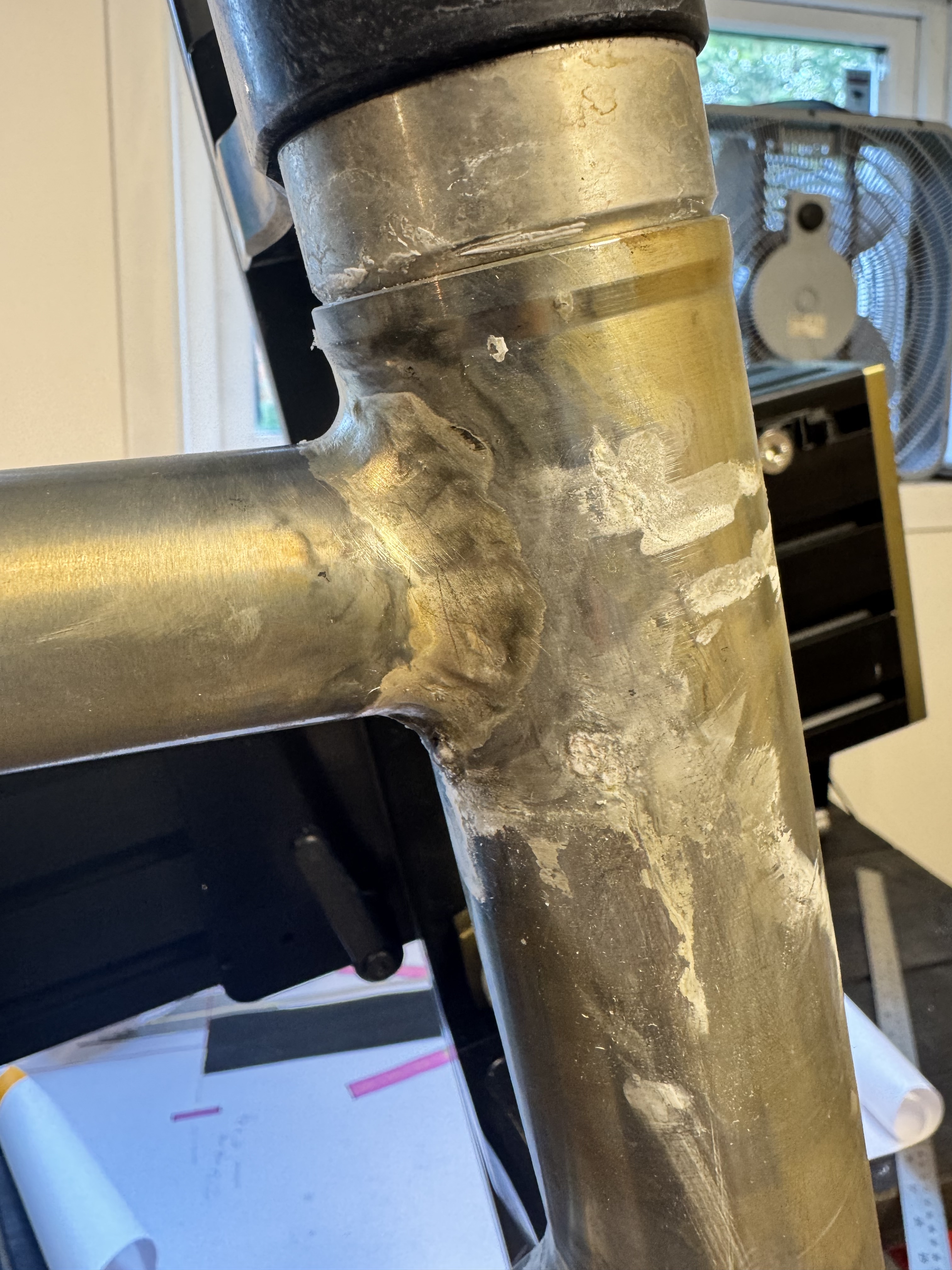
I’m a relatively new framebuilder and was hoping to get some pointers about fillet brazing. I have some experience with cromo, regular brass, and nickel silver; I was hoping to get into stainless-and-silver.
Some questions about materials:
I’m in the EU and don’t have good access to Gasflux, Cycle Design, etc. It’s all Fontargen over here.
About brass and nickel silver:
I’ve been using Fontargen’s F 120, which is a powder that is mixed with distilled water to form a paste. Datasheet says it’s good to 1100°C / 2012°F, but I find that I consistently overheat it (turns black and flat, sticks to filler and makes pinholes or messes with the general consistency / quality of the fillet). Is there a trick to this or a better alternative? I make it work, but repeatedly replacing cooked flux can’t be the way.
I’ve been told Castolin is worth looking at but I can’t seem to find anything they have that’s rated to a higher temperature. I did see they have a 1000°C product, but with nickel silver melting in the 900s that’s an even smaller margin than with Fontargen.
About stainless and silver:
I’ve been struggling quite hard with Fontargen’s F 300 H Ultra NT. It’s supposedly good to 800°C, which is sufficient for any silver filler on paper, but I’m definitely going over temperature on it before I reach flowing temp for silver rod. I’ve also tried F 300 HM (brown paste) which is good to 850°C but I didn’t like, and F 300 H Ultra BF (grey paste), good to 930°C, which worked well on my test pieces but I still ended up overheating when I tried joining heavy things to light things (for example, integrated flat mount dropout to chainstay). Any tips on material or technique here?
I’ve also found filler selection difficult. I’ve been mostly working with A 340 (40% silver) and A319 (34% silver). I find that the 40% flows great (almost indistinguishable from 55%) but can’t build up much of a radius (is this a limitation of the material or a lack of skill on my part?), and the 34% can build up a pretty nice fillet* but melts at a higher temperature than 40% so can’t go on top of it. If i try to flow the 34% into the joint, I usually end up overheating everything. Any advice here?
*even here I’m not satisfied. I can “get close” to what I can achieve with brass, but it’s always so close to tipping over into overheat and it happens so quickly. How do I get huge silver fillets like David Kirk does?
I’ve heard that stainless is quite intolerant of being overheated, that stuff precipitates to the surface that hinders wicking and adhesion. I did have problems with wetting the steel with filler at some point, and did notice a grey discolouration (although I didn’t get the usual heat stain on the bare metal that wasn’t covered by flux). Is that what is happening, or is that something going wrong with the flux? Even after sanding this layer off, I struggled to get filler to stick again. Are some steels more tolerant of heat than others? XCr vs 931?
General questions:
What are peoples’ favourite torches that are available in EU? I’ve tried the Greggersen Ergomax but found the valves rather sloppy and imprecise. I’ve tried the Messer Minitherm, which was great but got hot in my hand rather quickly and I wonder if I’m doing something wrong there.
I’d be super grateful for any expertise / knowledge that anyone can share!
Works great (Although I prefer Cycledesign) and I have built several steel and XCR frames with it. Nowadays I’m mostly TIG welding but I still use it to solder bosses and suchs.
My brazing set is a Gloor. Possibly not the most refined one, but it got me through about a hundred frames without any problems.
Thank you! Do you have any tips for silver brazing XCr? I can’t seem to make it work.
The Gloor torches I find with a simple internet search look a lot like my Greggersen, so we probably have similar equipment there.
I have a suspicion that I’m either overcooking the flux (the lowest temp stuff I worked with goes to 800° which is the same as what you’ve got), or I’m overheating the steel through the flux and it undergoes a structural change that makes filler adhesion very difficult? Is this something you have heard about / experienced / are cautious of? What filler do you use? What advice would you have?
Silver is pretty tricky to fillet, and indeed it’s a lot easier to overcook the flux, after which you’ll have to clean it all and start over from the beginning. Best tip I can give you is to make sure you slowly heat the whole joint until the flux tells you it’s almost up to temp and then get in and out in short stints. But it took me some time to get it in my fingers, it’s not as easy as brass brazing.
I use the 45% filler I linked in my previous post for pretty much all of my silver brazing, from bottle bosses to lugs and fillets.
I use Fontargen A210 and A120K for brass brazing, the K is more liquid and can form smaller fillets or a root pass if that is needed.
I’ve also experienced some problems with the F120 flux powder; I find it to be too coarse, it doesn’t really form a nice paste. I have switched to Gasflux Type “B” paste flux and find it to be working a lot better. A bit hard to get here in Europe, I ordered two large jars from the US.
Torch wise I have a Castolin MiniMax which is the same as the Messer MiniTherm, and a Messer Starlet. The Starlet is nice but very heavy, I only use it for brazing very thick stuff (mostly not bikes). The MiniMax’s handle does get a bit warm while brazing, I just use a welding glove…
Thanks for the tip! Gasflux is the internet’s firm favourite, it’s even quite affordable. Just the shipping is crazy.
I never even looked at A210K, I always used A101 for the root pass, because it also flows fast, is stronger, also has a slightly higher melting point than the A210, so less chance of messing up the internal fillet etc while building the external one. Do you think this is necessary?
But it does seem that the main problem is flux. Do you think grinding down F120 into a finer grain size would improve how it forms a paste? I will try this ASAP.
I also wear a glove with the Minitherm, and I’m glad it also gets hot for you-- that means there’s a lower chance I’m doing something completely wrong! Thanks for the tip with the Starlet, it looks to be roughly the same size as my Greggersen? Maybe I will replace it at some point, since I’m not too happy with it.
I’ve tried grinding my flux powder in a stone mortar with questionable if any improvement, at which point I decided to go with the Gasflux stuff…
I myself have never tried nickel silver filler, my thinking was that brass and brass mixed best I am not concerned about re-melting the root pass, why would this be a bad thing? But I am far from being an expert on these topics, maybe I’m just too ignorant
I tried an electic coffee mill which brought no improvement in it´s mixability.
I also tried it with heatet water on a stove over a period of time, still no improvement.
Do you have something you prefer to F120? Did you ever try any of the Castolin stuff?
@Luniz82 now that I read it from you, I guess it’s probably better to re-melt the root pass so it is one seamless piece with the external fillet. A void in there is probably not so good! So time to get some A210K.
Thinking about what you said, why would it be more prone to voids if you go over nickel-silver (can we just call it nickel alloy?!) with brass?. If the filler is up to temp and it wets out properly, it should be the same as a regular steel joint with brass? The steel never melts.
You can call Ralf Tschöpe from sonderlote.de by phone. He is really helpful in every way. Once we talked about my experiences with flux paste and he told me, a colleague is grinding the powder for a creamier flux. I don’t do that, I buy mixed flux, both for silver and brass.
No, I don’t use Brazetec stuff, just ordered a sample for a friend. He likes their brown flux. If the MOQs are too big for you, call them and ask what they can offer.
Mostly I use brass, silver, and flux from Sonderlote, but also Sifbronze and now some Italian silver, bought at schweissmaterial.com. Their prices were way lower in winter.
My Harris torch I do not recommend, the valves are not that accurate and sometimes change the flow rate on their own. But they have a wide range of tips, also really small ones, very useful for braze-ons and other small stuff like stainless racks.
I use Meltolit 34SnF flux coated rodes to braze mainly Reynolds 853. I have some XCr tubes that i was planning on brazing 40% silver from the same supplier.
I use flux paste from the same suppliers: 770 for the 853 and 770E for stainless
Still burn a bit of the flux towards the edge on occasion where the flux thins out, but builds a nice fillet. This is straight from clearing the flux residue off:
I’m using Fontargen fillers too.
In the beginning I tried a lot different materials but I ended up with Fontargen 303 (20% Silver) for alsmost everything.
When I made my first frame I made two passes: A first tinning pass with Nickel Silver and a second one to build up the fillet with brass. It worked somehow but the high temperatures needed for Nickel Silver were allways burning the flux.
With Fontargen 303 the needed temperatures are much lower. On the other hand the filler is going in more or less every small gap and is building up an inner fillet easily. And you can form a nice outer fillet so only one pass is needed.
 I am not concerned about re-melting the root pass, why would this be a bad thing? But I am far from being an expert on these topics, maybe I’m just too ignorant