Curious if anyone could help me answer this question.
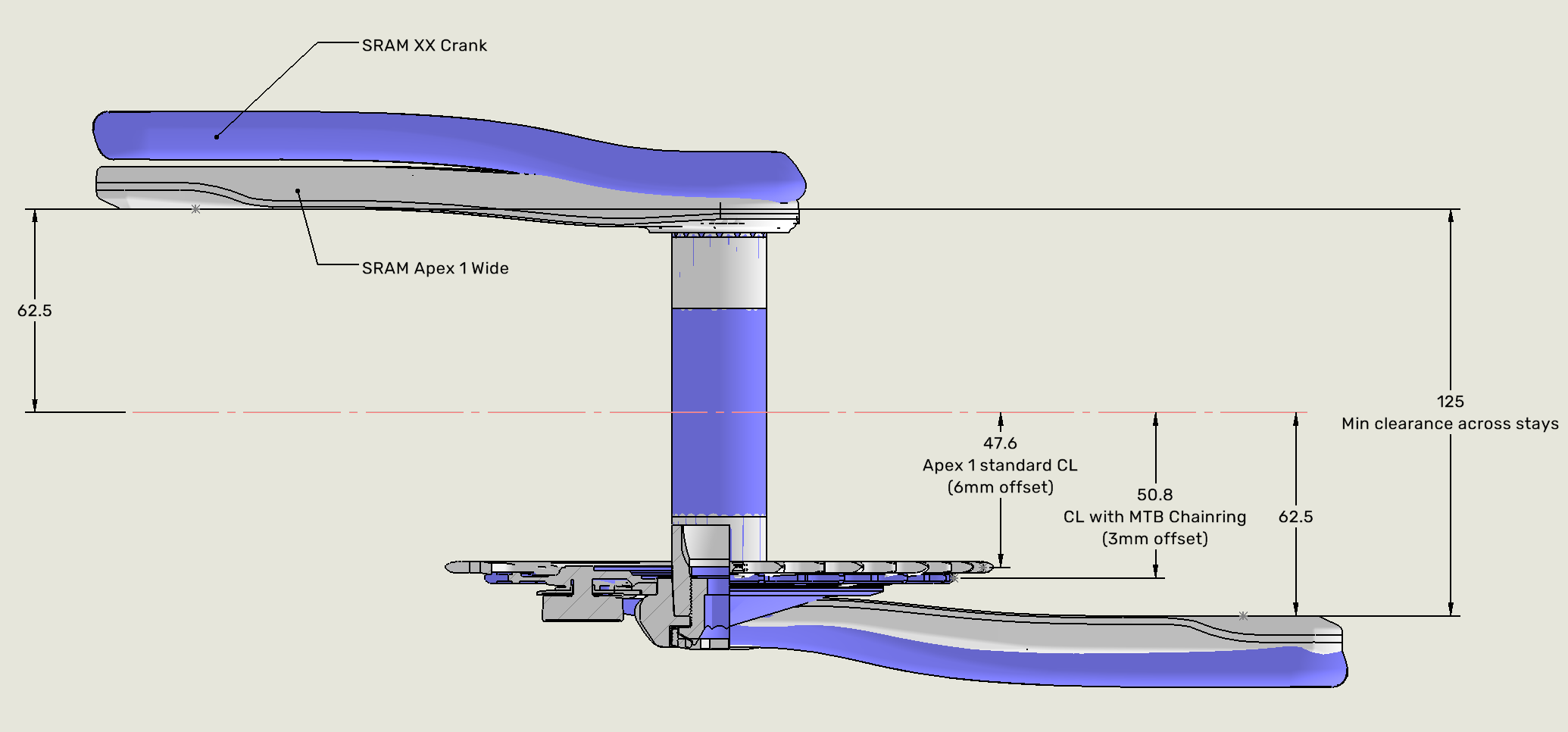
I’d like a gravel bike with 32” wheels, and I think its prudent to design that around mtb boost hubs. However, I don’t want to use MTB cranks if I can avoid it because I’m worried about the q-factor of a wider crankset.
Specifically, I’m looking at using a SRAM XPLR AXS groupset (the new E1) with a power meter and the threaded chainrings.
I was wondering I might be able to use a +0mm offset chainring from the MTB groupsets on the XPLR threaded power meter crankset instead of the +6.5mm chainring it uses by default. This would do two things: (1) bring the chainline out to 53.5mm (much closer to 148mm boost’s intended chainline) and (2) give an extra 6.5mm to squeeze in a driveside chainstay.
Anyone know if this is possible? I’m not sure if the chainring would interfere with the cranks. Are there side effects I’m not thinking about?
@JMY , thanks so much for doing that. It certainly seems plausible at least? I think the biggest risk might be the chain hitting the crankarm when it is on the smallest cog.
SRAM support got back to me and essentially said they’re not willing to offer an opinion on it.
I am afraid I have to say that the XPLR E1 groupset is not designed or tested with 148mm hub spacing, and isn’t technically compatible with that system. So I can’t really give much support to your situation without having support behind it. We recommend a 142mm rear hub for XPLR E1.
For an MTB boost rear end, I’d highly suggest using a compatible T-Type set if at all possible with our boost setup to ensure things work properly.
Just use a mtb groupset/cranks? I’ve space out my gravel bike to run on boost cranks, AXS and transmission will work with road shifters or are you trying to reuse a groupset you own?
I am worried about the ergonomics (aka knee pain) of a bike with a significantly wider q-factor, but perhaps I am being too paranoid? I should probably just put my preferred gravel pedals on a mountain bike this weekend, go on a very long ride, and see how it goes.
That sounds like a very conservative reply from SRAM. I get it though, they’ve not designed the system with your use case in mind. And that’s fine.
All we need to do is to look at the info we know for sure, and we can extrapolate from there:
1. Does the MTB chainring fit on the Force crank?
Yes, it seems it will.
2. What’s a normal SRAM AXS (12sp) 1x chainline for a 142mm rear hub?
45mm for non-wide (road)
47.5mm for wide (road/gravel)
49mm for MTB (non-boost)
3. What’s a normal SRAM XPLR AXS (13sp) chainline for a 142mm hub?
45mm for non-wide (road)
47.5mm for wide (road/gravel)
4. Chain compatibility?
Officially, Flattop road chains only on XPLR cassettes. But they are compatible with both 12sp and 13sp.
Officially, T-type flattop chains only on 12sp T-type MTB cassettes
Eagle T-type cassette and chain can officially be used together with a Rival, Force or RED crank/chainring.
5. T-type “mullet” drivetrains
Gravel cranks (wide) and a T-type cassette + chain is an officially supported combo
Ideal chainline for a T-type cassette in 148mm setup: 55mm.
Extrapolated ideal chainline for a T-type cassette in non-boost setup = 52mm
Approved “mullet” drivetrain chainline: 47.5mm
Ideal vs. approved chainline difference: 52-47.5mm = 4.5mm
To this, I can add that I’m running a T-type cassette and chain with a non-wide road crank (45mm chainline), which adds another 2.5mm difference from the ‘ideal’ = 7mm difference in total, and it’s been working well for me. The chainline is extreme when running on the smallest cogs, but for mid-cassette and climbing gears, the chainline is actually better than a standard setup.
The only unknown at this stage is whether an XPLR cassette and derailleur can be used with the MTB chainring. It’s not officially supported, but I’ve seen plenty of reports saying that a ‘regular’ flattop chain will still work well on an Eagle Transmission chainring & cassette.
This means that your best bet is to run a 148mm hub with an Eagle Transmission cassette, derailleur and chain with a Force crank fitted with the MTB chainring. In this setup, the chainline difference from ideal to actual is only 1.5mm (55-53.5mm). So technically, this should work very well as the chainline is well within the limits we know are approved, and all the drivetrain components are also compatible since they’re all of the MTB variety.
Though it still seems highly likely that a 13sp XPLR cassette and chain will be a workable option.
That was a very helpful reply, thanks @JMY . After going back and forth on it a lot though, I ended up deciding to go with a MTB crankset. I think the risk of a wider q-factor bugging me is low enough that I don’t want to deal with all of the weirdness from a mixed drivetrain. More importantly though, this will allow the bike to clear 2.4” tires, which seem to be the majority of the 32” options at the moment. I’m hoping this will make the bike more future proof and flexible in the future.