Hi, I’m new posting here…but like many have been lurking around absorbing as much info as possible. Amazing to have this info freely available!
Question, silver brazing (30-35%) of the total frame is normally/commonly used for stainless frames from my understanding as a lower temperature, more controlled method of brazing. Ignoring the cost difference. Is there a fundamental reason why more folks don’t not use it on your typical air hardened tube sets? Given the lower heat input and associated benefits, easier clean up and the increased joint penetration? I understand that its effectively a weaker joint, but its still stronger than the tube itself (assuming it’s done correctly).
A little insight from the experienced would be appreciated.
On stainless tubes like 921, Reynolds say, “Austenitic stainless steels such as 921 can be susceptible of inter-crystalline cracking when brazed at high temperatures. It is for this reason that Reynolds recommends the use of silver braze alloys with working temperatures of between 670 and 750°C”
But my understanding is that air-hardening steels (631 and 853) actually like a bit of heat. That’s what “air-hardening” means— you’re essentially giving them a heat treatment by TIG welding them.
I don’t know if brazing is hot enough to give you that air-hardening effect (Reynolds don’t mention this in their document). Certainly brazing air-hardening tubes doesn’t do them any harm, and many people do this, but you probably don’t need to worry about heat input especially. But I will leave the finer points to people who know more about brazing (I TIG everything).
Dutch builder ST joris is using only silver on their regular steel frames as they feel less heat means less distortion (If I remember right.)
I have used silver to braze chromoly toptubes to seattubes as I thought it would prevent too much distortion there, but once I got my temp control better I’ve moved back to brass. (And now pretty much just TIG) Main reason not to use silver is price, and the fact that filleting with silver is a bit more tricky than with brass.
Thanks of the replies. I wasn’t aware of St. Joris (Materials & Fabrication - St Joris Cycles) thanks, looks pretty fancy with a lot of perfection mentioned . Also, Big forrest frameworks in Germany only use silver brazing too…where i learnt to braze, hence my curiosity on why its a far less common method.
So the probable overarching reason is material cost?
You can certainly use silver for 4130 or air hardening steels. It won’t get hot enough to actually realize the benefits of the air hardening but it’s still plenty strong. I use silver around the seat cluster so I don’t remelt previous brass joins and all braze-ons, bridges etc. My guess is the cost is primary reason people don’t use it and there isn’t really any benefit (other than for stainless obv).
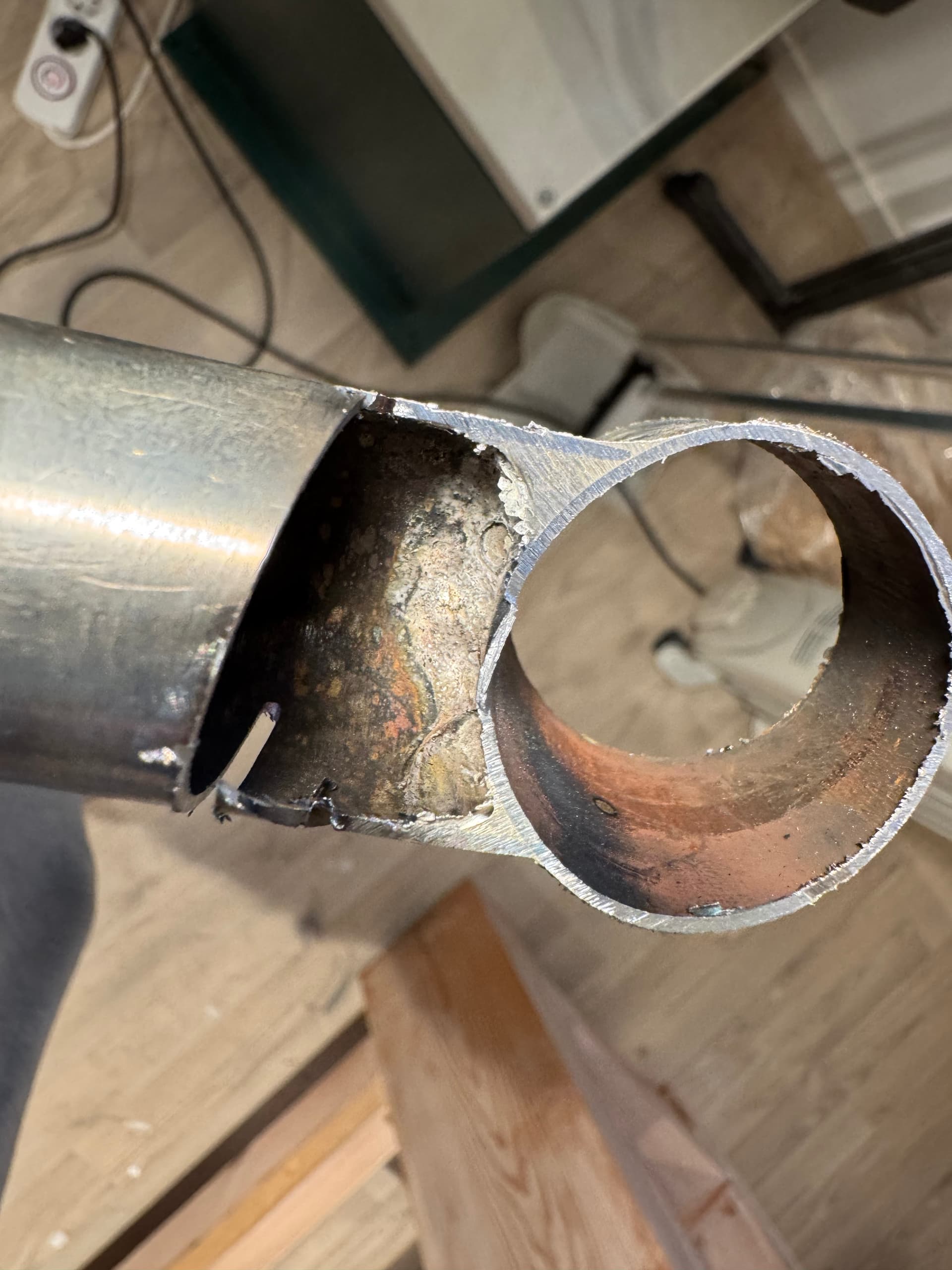
Maybe to move this thread a slight different direction: i was playing around with flowing silver inside the joint (mitter was just a very quick hand file job) and then cut it open. Braze was tiny on the outside, but pretty substantial…but not uniformed on the inside.
I think it’s an old technique? But from what i read it’s not great from a fatigue perspective…but that could be total poop
Any thoughts or knowledge on its actual strength? I couldn’t budge it in the vise
I use silver on my top end road frames and a mix of silver and bronze on the mountain bikes. My first full sus is entirely in silver, fillet brazed. 38% from memory and still holding on after lots of abuse. I moved back to bronze for most stuff these days unless Im using a stainless 3d printed part. Much cheaper and I find it a lot easier to shape with the torch.
Brass brazed and even TIG welded frames get to silver brazing temps at some distance away from the joint. Also braze-ons are typically silver brazed. So there willl definitely be tempered zones from being raised only to silver temps, various places on the frame.
I’m no expert but I assume the size of the tempered zone and exactly how much tempering it got depend mostly on the total heat input, and not so much what the temperature was. For example TIG has the smallest tempered zone (I think, correct me if that’s wrong) despite the higher temp, because it’s concentrated and quick. The self-quench from the adjacent room-temp tube pulls the heat down rapidly before the tempered zone moves further away. Brass probably makes the largest tempered zone and silver will be less, providing you work quickly and don’t dawdle.
I hope everyone here knows that going back over your fillet to improve the aesthetics is weakening the steel. The sooner you turn the torch off, the stronger the frame. Git ‘er done!
This is why I don’t get the ‘tinning’ pass that some use. On the flip side, empirically, there are many frames out there with huge fillets that have lasted decades.
@Marf I’m going off memory, and I’m no expert on these but I think you may be referring to internal filleted Peugeot and other french bikes from the 70-80s. I believe, these weren’t flowed in from the outside but used a pre-form inside the tube and were melted out. There are many ways to braze a joint and the fillets (internal or external) don’t need to be big.
Yeah, the steel in the tempered zone still has tolerable strength, it’s not like it’s annealed, just down a bit from the as-delivered state. Many frames have lasted a century or more with a big ol’ HAZ, usually by being made with stout enough tubes.
You recently repaired an early Ritchey as I recall, did you weight it? I’m gonna guess it was not very light by modern standards. Whole lotta brass in them fillets, but he chose heavy enough tubing. It’s when you push the envelope weight-wise that you need to up your game strength-wise.
On the other hand some riders have the ability to break almost anything. You hope you don’t get too many of those guys riding your bikes. Unless they come to you because they already broke multiple frames of other brands, so they know frames break sometimes. We sponsored a Race Across America racer who was a big-gear masher, stood on the pedals a lot, and of course racked up huge mileage. And he liked small diameter thinwall tubes for comfort. He broke about a frame a year.
One more thing to take into account is the cleanup time.
In my experience, silver fillets are easier and quicker to file/sand/finish, so if you’re building with a time quota in mind and don’t leave your fillets raw, that can also be a consideration.
I wouldn’t say it’s 12 times quicker though, so the time saving would not offset the higher cost on its own. The decision has to be made taking the other benefits and downsides into consideration to figure out what best suits your own situation.
Looking at the pictures, I think you’re right. I wish I had done a better job of documenting the measurements, angles and weight. The DT is nearly same size as the HT from pictures so it must be 1-1/4’’. To your point, it was heavy.
 . Also, Big forrest frameworks in Germany only use silver brazing too…where i learnt to braze, hence my curiosity on why its a far less common method.
 . In Norway they’re 200kr+ (€17).