Hey internet - I’m designing a new hardtail for myself and am running into a issue with my stack dimension. If I copy the geometry of another bike into my model I am consistently getting a higher stack number (about 20mm). I have modeled in the thickness of the Cane Creek EC44 lower cup (12.5mm), and am planning on a 130mm suspension fork with a 44mm offset. Can anyone see anything obviously wrong with the image below? I must be overlooking something obvious.
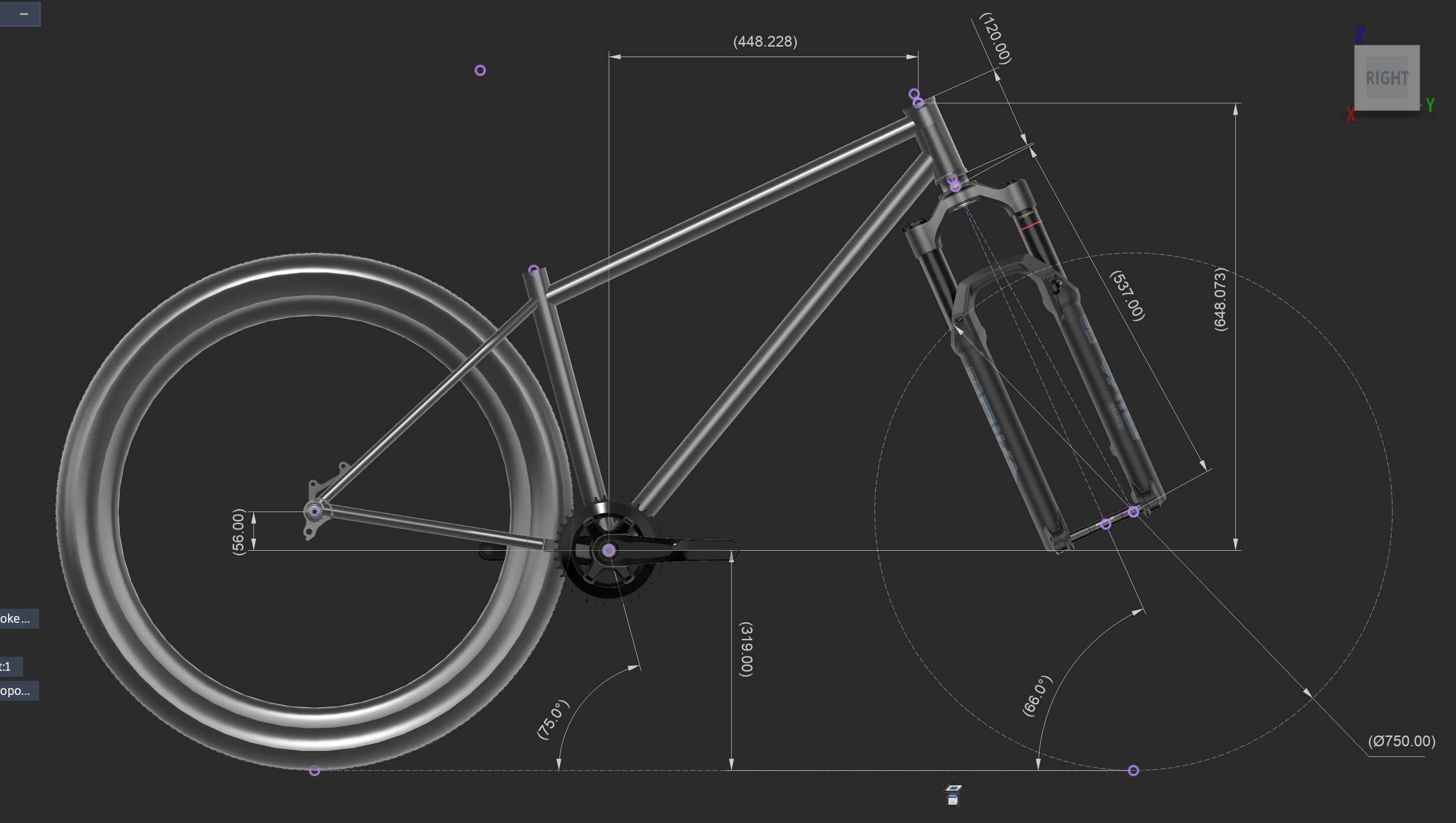
Your axle to crown measurement (537mm) looks to be measuring a direct line, when the measurement should be made parallel to the steering axis. That’s not a huge difference, but also, depending on the geometry you are comparing with, the measurement could be taken with the fork partially compressed (at sag usually). It would be useful to have that to compare as well.
Edited to add:
There is also huge discrepancy between bottom bracket height, bottom bracket drop, and what the actual tire diameter is. Most brands don’t state what size tire they use to calculate bottom bracket height and that will change how stack is measured as well.
I have had that dimension measuring along steering axis and as seen in my pic and it only changes it about 1mm. I did some reading on here and it seems like most brands share their dimensions with no sag, so again I’m at a loss.
Most geo charts from the bigger brands have errors in them. They can’t be 100% trusted. Draw in what you want the stack to be and model to that.
1 Like
Does the bike you are copying use an integrated headset?
No it’s just a standard 44mm head tube, so lower cup is external and upper is internal. That adds 12.5mm of stack compared to some other bikes with the tapered head tube.
Great advice.
If I am not mistaken, there are two types of fork lengths described mathematically.
- axle to crown measurement is indeed the “actual fork length” as it is a measurement of the direct linear distance from the axle to the crown.
- the “on-axis fork length”, as it is described by some CAD software and bike geometry references, is the measurement of the linear distance measured along a line parallel to the steering axis (from the center of the front axle to the crown race seat/base of the crown).
- NOTE: the actual fork length (axle-to-crown measurement) takes in account fork rakes, whereas the on-axis fork length does not.
This is also similar to how some Bike Cad software describes top tube lengths. There is an actual top tube length and an effective top tube length. The actual top two length is the distance of the top tube from the center of the HT/TT to the center of the ST/TT. The effective top two point is the theoretical horizontal top tube as measured from the HT/TT to seatpost/TT. The actual top tube length factors into the measurement the angle of top tube slope, whereas the effective top tube length does not because it is a theoretical measurement along an imaginary horizontal line.
This is also similar to how some CAD software for bikes describes “actual chainstay length” and effective chainstay length. There is the actual chainstay length which is the actual measurement from the BB to dropout. And then, there is a theoretical or “effective chainstay length” which is the horizontal distance from the BB to the vertical plane of the dropouts. The actual chainstay length factors drop into its measurement, whereas the effective chainstay length does not because the effective chainstay length is measured along a horizontal imaginary line and not the actual chainstay line.
537mm sounds like the unsagged A-C for a 130mm fork (I’d really expect 541mm for Fox and RS, but 537mm is close). Manufacturers of hardtails aren’t consistent in using sagged or unsagged geo, but if you look up a sagged geo you’ll see a shorter a-c and stack.
Preload/sag on a 130mm fork will reduce a-c about 30mm give or take a bit.
Your geo looks almost spot on for a medium Kona Honzo made in the last 5 years. Their geos are unsagged.
Copy that! Thanks for the help.
Also, you should design with sagged fork lengths. Designing with unsagged lengths is just weird. I don’t know why manufacturers list geos that way.
To compute sag take 20-30% (depending on how you like to setup your fork) off of the fork travel and subtract that from A-C. So a 120mm fork that is 531mm with 20% sag would be reduced by 24mm (120*.2) to 507mm. Or a 552mmm 140mm fork with 25% sag would be reduced by 35mm to 517mm.
2 Likes
I think you answered the question of why static geometry is used.
2 Likes
But static unsagged geo matches no forks that anyone would use. So that’s not a good geo to publish either.
Can you imagine if road geos started randomly being published 1-1.5 degrees slacker than reality and with a BB 15-20mm higher? No one would want that.
but what sag number are you going to choose to do geo at? 20% or 30%? Everyone know that individual rider setups will vary the final geo outcome but if we all start at the same point it’s much easier to track.
1 Like
I’m also in the unsagged camp for design.
Unsagged geo is measurable in real life.
Sag amount varies, and is just an arbitrary number. The bike isn’t riding at 25% travel any more than it is at 50% travel. I’d argue that the geo of the bike deeper in the fork travel is actually more important to think about since that’s when the most dynamic riding is happening.
Yeah. Initial sag settings are variable dependant on the rider, fork, bike, terrain, all the above. And, once you start moving along on a bike, its constantly variable. That’s the idea of sag.
We need a known base figure - the static geometry. Everything else should be extrapolated from there.
For a 130mm fork the difference between 25 and 30% is 6.5mm, or about a 1/4 degree. That’s basically in the noise. But the difference between 0% and 25% is 32.5mm, or about 1.5 degrees.
I do agree that handling deep in the travel matters and should be considered too.
What can be measured is all a matter of how you choose to measure it, right?
1 Like