I think it’s one basically one guy (John). He appears to have designed and built basically the whole process in house, including filament-winding his own carbon tubes. Geo (and no doubt other parameters) completely custom. He’s also designed his own headset and bottom bracket systems. Scope of judgment: total. Innovation: high. Risk: high. But it’s all made by machines. Small machines, in his shop, that he programmed, and some of which he probably assembled. Certainly no traditional frame-building skills like welding or brazing going on.
But those ARE traditional framebuilding skills. Not my focus of interest, but traditional nonetheless. We need to understand that the word traditional doesn’t mean of the past, or done in a certain way.
Here’s a quote I like to add in times like these:
*Tradition is sometimes confused with transmission. Copying Momoyama pieces is transmission. Producing contemporary pieces incorporating Momoyama period techniques is tradition. Tradition consists of retaining transmitted forms and techniques in one’s mind when producing a contemporary piece. Tradition is always changing. A mere copy of an old piece has not changed; it is nearly the same as its prototype of four hundred years ago. Tradition consists of creating something new with what one has inherited.
*
I’ve always thought the violin industry is a really interesting compare/contrast with frame building.
Both are made up of individual builders as well as factories of all different sizes. This production structure has been true in the violin world for centuries. The only things that have really changed is the location of the large factories (first Western Europe, then Eastern Europe, now China), and mechanism of production in the factories (hand tools, then manual machines, now CNC). Though they still use hand tools in the large factories.
Like the frame world, the violin world has a rich history of passionate makers in their basements making a go of it. Maybe producing only a few instruments, or maybe hundreds. They have to compete on price, and prove their value in relation to factory models, all while trying to keep the lights on.
Evaluating the instruments is similar to bikes. There is the visible quality of construction and finish (which is often deceiving, especially to the inexperienced), and the hard-to-define quality of tone and playability (ride-quality in bikes). The experienced can usually see through the bullshit, while the rest of us just see the pretty finish.
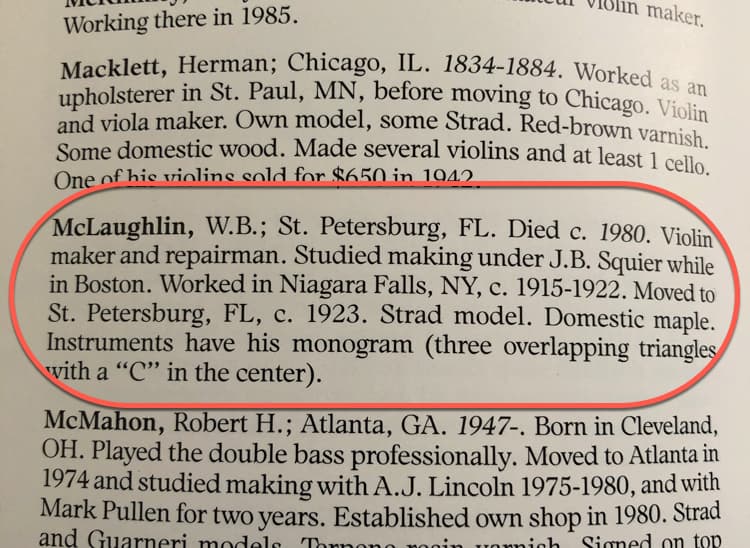
A big difference exists in the violin world, that I think points at what @EllisBriggsCycles is getting at and striving for. For violins (and bows), much of their value is based on who the maker was trained by. Often the lineage and training of the maker has a much larger impact on the value of an instrument than the actual quality and condition of the instrument itself. See the attached image for an example of how makers are documented, which dealers use to help value instruments.
I’ve always thought the violin industry is a really interesting compare/contrast with frame building.
exactly - i have been saying this since the early ‘70s, and i’d include haute horology *(independent watchmakers) under this umbrella. i could go on, and probably bore 3/4 of the readers here, but i’m off to my biweekly deep tissue massage.
Super interesting thread. I don’t have a huge amount to add. I agree that you’re likely to find the same conversation going on in many fields, add pottery, optical instrument making, to horology and musical instrument making (of all kinds).
Sennet was mentioned as he is one of the key authors in my research. That book is great. Thanks for referencing it explicitly. I recommend the reading to anyone interested in these topics.
That was a 531 main triangle, 753 rear stays. 753 was launched in 1976, first ever heat treated tubeset, based on same material as 531. To build a 753 frame set, each builder had to be certified by Reynolds, by sending a sample BB area silver brazed work. To ensure not over heated. Yes. 653 was for riders who wanted a more ‘compliant’ frame.
But the front triangle won’t be more compliant. 531 has the same elastic modulus as 753. The front triangle will actually be stiffer if the 531 is thicker wall. (But actually with 653 I think it was the same gauge as a 753 tubeset).
This was my point: the misconception that heat-treating makes steel stiffer was (and still is) quite widespread. Perhaps because it’s harder to yield it if you’re trying to dimple or bend it people (incorrectly) intuit that it’s stiffer including in the elastic region.
I think we all know this nowadays, but I think it shows how much more “myth and lore” still held sway back in the 70s and 80s
Just passing on information on this. The full answer was “Yes. But say that 653 was for riders who wanted a more ‘compliant’ frame . You know that in engineering terms is not really true.”
Actually in that recent GCN “welding vs brazing” video heating was discussed, and it was mentioned (correctly I think) that brazing heats up more of the metal whereas TIG is very focussed. But then it was suggested (incorrectly) that this fact would affect the stiffness and potentially even the ride feel. Still a pervasive myth.
That felt like a glass of red wine and a french cigarette moment after reading all of that.
I have lots of thoughts but I just want to say that all I want to do is make great bikes. I use modern methods of fabrication mixed in with methods that have been around for a century. I couldn’t do any of this without learning the basic fundamentals at the start. The judgement calls I make now are born from what I experienced and the mistakes I made learning those fundamentals. Whether it’s craft or manufacturing I don’t really care either way. I love making stuff but I also want to have a successful business making stuff.
….but to Elli’s point. I can’t employ or take on an apprentice to allow the craft side of what I do to be passed down. I am in a fight for business survival. Until the market changes and values the hand built bike sector more and I can make sell more bikes and have capacity/need for employees then tehre will be no passing of the flame.
Interesting that Paul Brodie’s excellent YT channel (from which I have learned many things) was partly set up by him because the framebuilding course he used to run was made excessively expensive by admin at the university it was at. He’s not doing the channel for the money, and makes very little. People with knowledge quite often seem to want to share it.
There are many dimensions to this debate (autonomy, judgement, processes, efficiency, the quality of the final product) but also where you learn the skills in the first place. That’s been blown open by the internet and YouTube, and now we have a whole generation of amateur “homo faber”s.
Learning the skills from YT rather than from someone whose apprentice you are is harder, not easier. You will need more practice and to exercise more judgement. But it does create more opportunity.
It isn’t about economics. As Zach Gallardo (YT fixed-gear influencer who has recently got much more competent at bicycle mechanics) put it, “when you work on the bike you work on yourself”.
The passing of the flame part also includes telling your story and being open about the journey. It’s up to others to take something from it. But at the very least, remain honest and vulnerable.
That’s why I post on IG etc and hang out here with all you cool people. I feel like I have something to offer as I didn’t come through the old school way and to be honest there wasn’t much on YT when I started. So while I can’t see a time when I’ll be big enough of a business to have an apprentice, this is how I give back to my peers.
That word. I think (*) we need to get past that word. Though it may be a separate conversation, and while I fully support Paul’s efforts to resuscitate the trade in Great Britain, we’ve never had an apprenticeship system in framebuilding. One would either take a starting position at a factory, production house, or at some family business where frames are made, and stay long enough to get bored and leave or endure the many cycles of training necessary to absorb the basics, and then decide whether or not to go it alone. Other trades may have, or have had, real apprenticeships, but ours never did.
Yes, I’m fixated on the term, perhaps because it’s misleading as it relates to the process of gaining all the knowledge and hands on experience needed for competency. I also think the term, hobby framebuilder, does a disservice to the conversation. That’s because, I think (*) the number of failed attempts at least since Y2K lowers the bar for all of us invested in a life of practice.