I have questions regarding framebuilding from discarded/crashed steel bike frames.
EDIT: this is for personnal use, not for customers (I’m not selling frames)
My reflexion comes from several perspectives:
Trying to minimise the ecological impact of building/producing stuff (although it seems more and more like a drop in the -burning/plastic- ocean nowadays)
Thus repurposing steel instead of using new tubes
Mix and matching hard to find tubes (mostly regarding shapes)
Building/expermenting on a budget
My goals are:
Building mini (cargo)bikes from heavier/sturdier vintage mtb tubing (I’ve already done it a couple of times and it seems to hold well + I’ve seen it plenty of times IRL and online - “Berlin mini bike fest” seems to an epicenter of the idea)
Building slightly smaller “performance” frames (all road/gravel) from thin wall tubing out of dead bikes (this is where I think it might get sketchier)
My understanding of the topic so far (and here is where I’d like to have your thoughts/inputs/corrections):
Cutting the tubes shorter means I would have to be extra careful regarding butt lengths (especially with higher end tubing)
welding/brazing affects structutral integrity of the tube near the welding/brazing. If I understand it right, tig welding has the “strongest” HAZ but also on the shortest distance, meaning theorically that I could cut the tubes quite close to the notch without losing too much material property? On the opposite side of the spectrum silver brazing (for lugged road bikes for example) shouldn’t affect as much the tubing but the HAZ would be on a bigger zone.
If this is correct, would it make sense to think I should be safe doing mini bikes, or smaller sturdier frames fillet brazing (brass) them with “thick” mtb/touring tubes?
Using the same logic would you think it would be safe to silver braze (38%?) the higher quality/thinner tubes (ex: columbus Max etc) to avoid making the tube brittle and prone to tearing?
Would there be a rule of thumb that would allow to calculate the resistance of an already welded/brass brazed/silver brazed in order to use the right amount of tube thickness and right material to do the joints?
Is there a way to calculate the size of the HAZ regarding the welding/brazing technique and wall thickness?
Much thanks for reading this long reflexion/request already
IMO, if you’re making something for a customer, never use something you can’t trace back to a supplier. I’m in the US, I have insurance and take making bikes seriously. I don’t re-use tubes even for practice material. The paint and chemicals are nasty. Yes, this is a privileged perspective and I value my health.
If you’re making stuff for yourself or you’re in a country that isn’t as litigious as the US, do whatever makes you happy.
From a bike making perspective, those tubes have been stressed in ways you don’t know. Is that a risk you want to put your reputation on?
Hi Karmawheels. You’re over-thinking it. Your welding and brazing skill and technique, and internal rust in the reclaimed tubes, will have a much bigger effect on the strength and longevity of anything you build than what wall thickness you’re using or if there’s any butting left in the tube. Also engineering, how things are braced, how the load carries through the structure and how it flexes - you can’t adequately predict these things with a set of eyeballs and common sense. Everybody inventing cargo bikes is just trying stuff out and seeing what works. I have done a lot of frame reapirs in the last 20+ years and I have seen expertly welded cargo bikes, professionally engineered, built with the best welding and best materials (steel and aluminium too) experience critical failures (crack). Critical but not catastrophic. Steel isn’t going to explode on you, cracks usually show up with a creaking sound, spread slowly, and rarely sever a tube. Even in the case of severage there is usually enough stuff holding on elsewhere that you can come safely to a stop, sometimes even ride it home. Paris-Brest-Paris 2011 I arrived in Brest with a crack 3/4 of the way around the bottom of my seat tube and I was still able to ride 20 km out of town to find a farmer who had a welder in his barn. Let me tell you, that repair was probably rougher than anything you’ll ever do on your own projects and it still held for years and thousands of Km’s after that. So get out there, start sticking some metal together, and go have fun.
Thanks, I like that perspective! Indeed, I’ve seen plenty of high quality bikes broken at some point (whatever the material) and indeed all the steel ones seems to hold up pretty well even when a crack starts (I’ve seen a few people keeping riding those, not having noticed it besides the sound). Also for mini bikes and mini cargos it’s a lot of trial and error, and I’m not really afraid of experimenting because of the structures being smaller, and also the fact I’ve only used thick tubes for that intent so far. I guess I’m more concerned about the durability of a frame I’d like to do for my size using higher end and thus quite thin ( and brittle?) tubes for an allroad/gravel bike. Anyways as you mentionned, I guess worst case scenario would be something like you experienced during PBP.
I disagree with this. Many who are hacking together cargo bikes may do this but the folks I know making cargo and utility bikes aren’t just making stuff up.
Ask your local powdercoater to strip the donor frames for you. Stripping paint is an awful process and home and not good for you or your workspace.
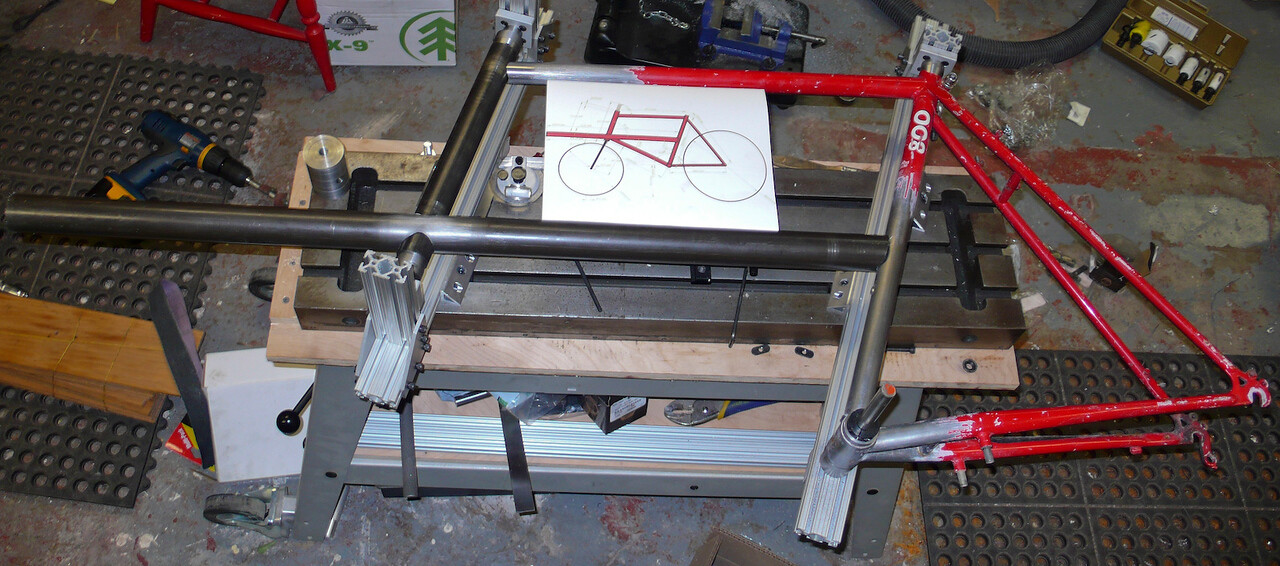
I started out in building by making cycletrucks with donor frames. In my case it was a good way to get an intact rear triangle before finishing that portion of my frame jig.
I did measure any tubing that I reused to understand wall thicknesses and where the butting taper was. It’s easy to run out of the butted end when reusing frame tubes.
Here is the first cycle truck that I built, based on a 1990ish Trek 800. It’s still in use. That old Bridgeport milling table was both my fixture base and alignment surface.