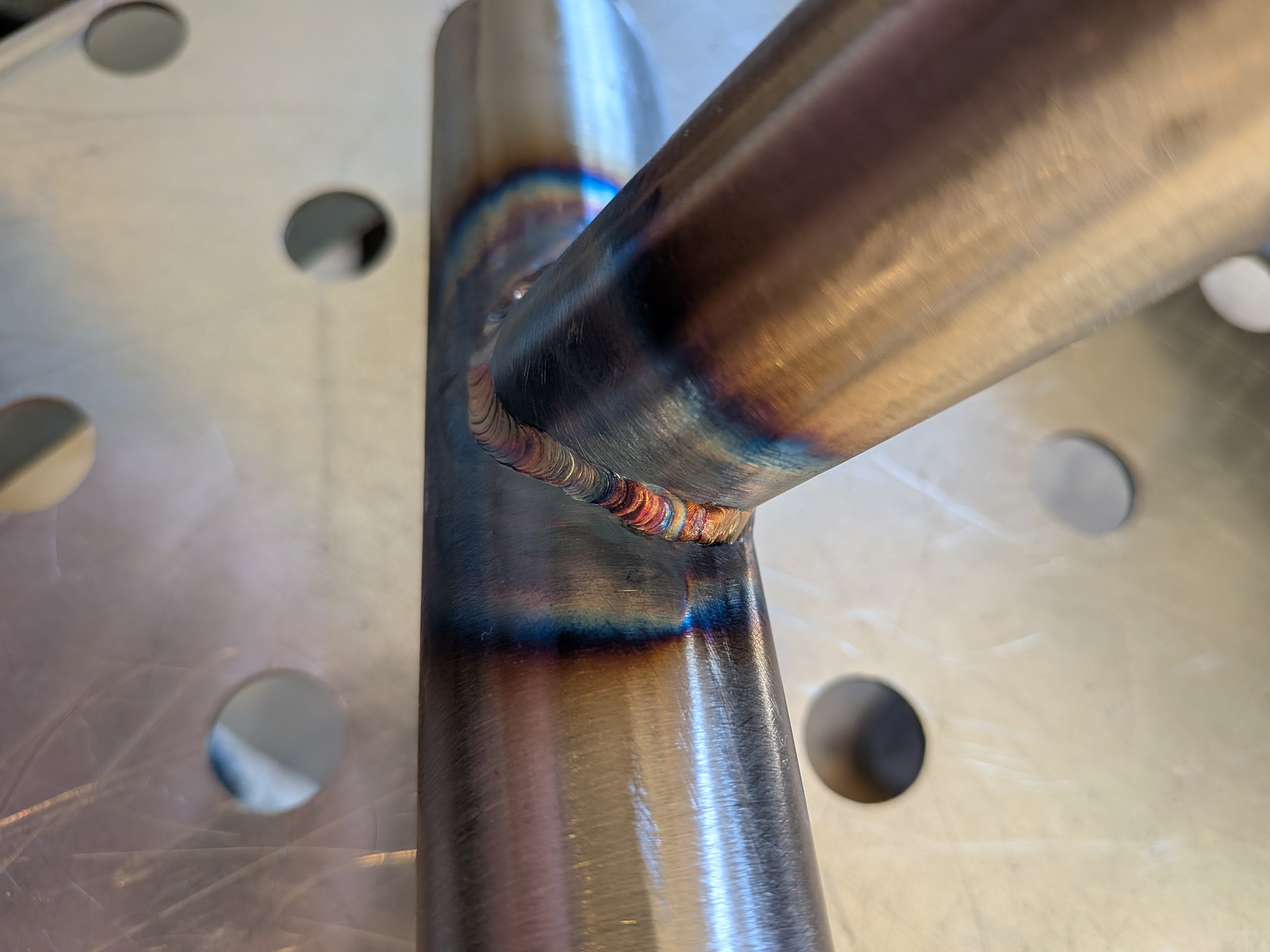
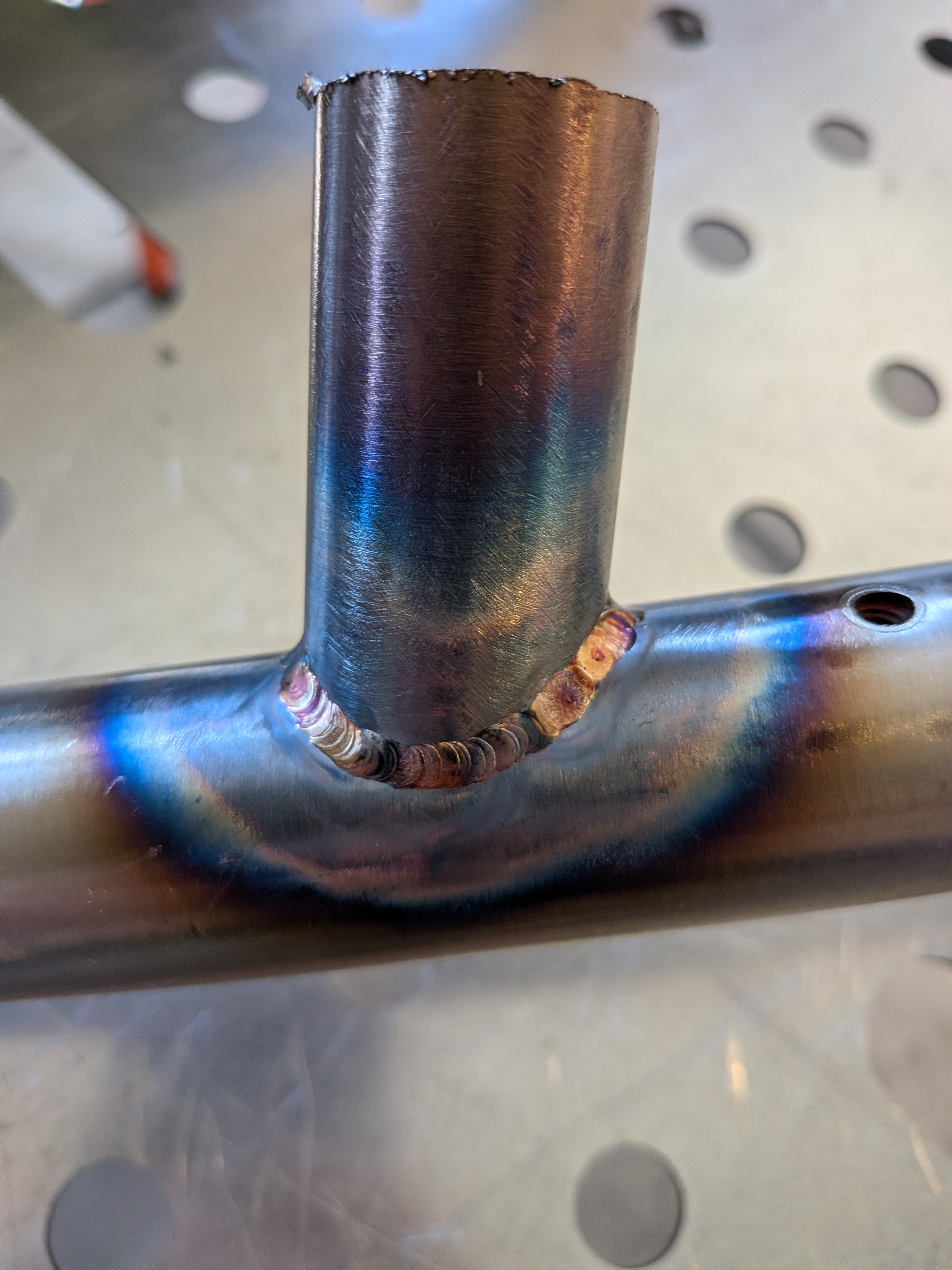
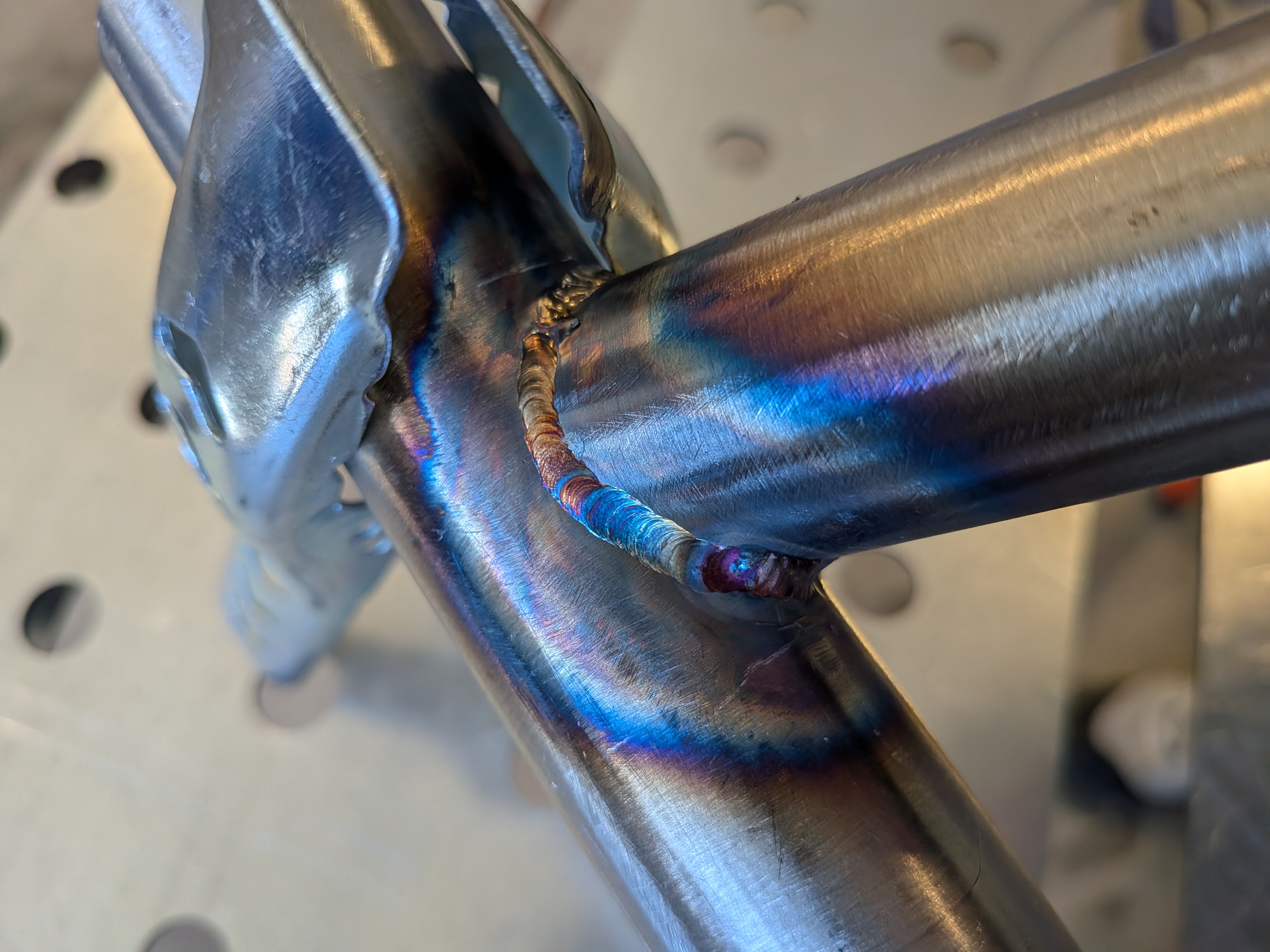
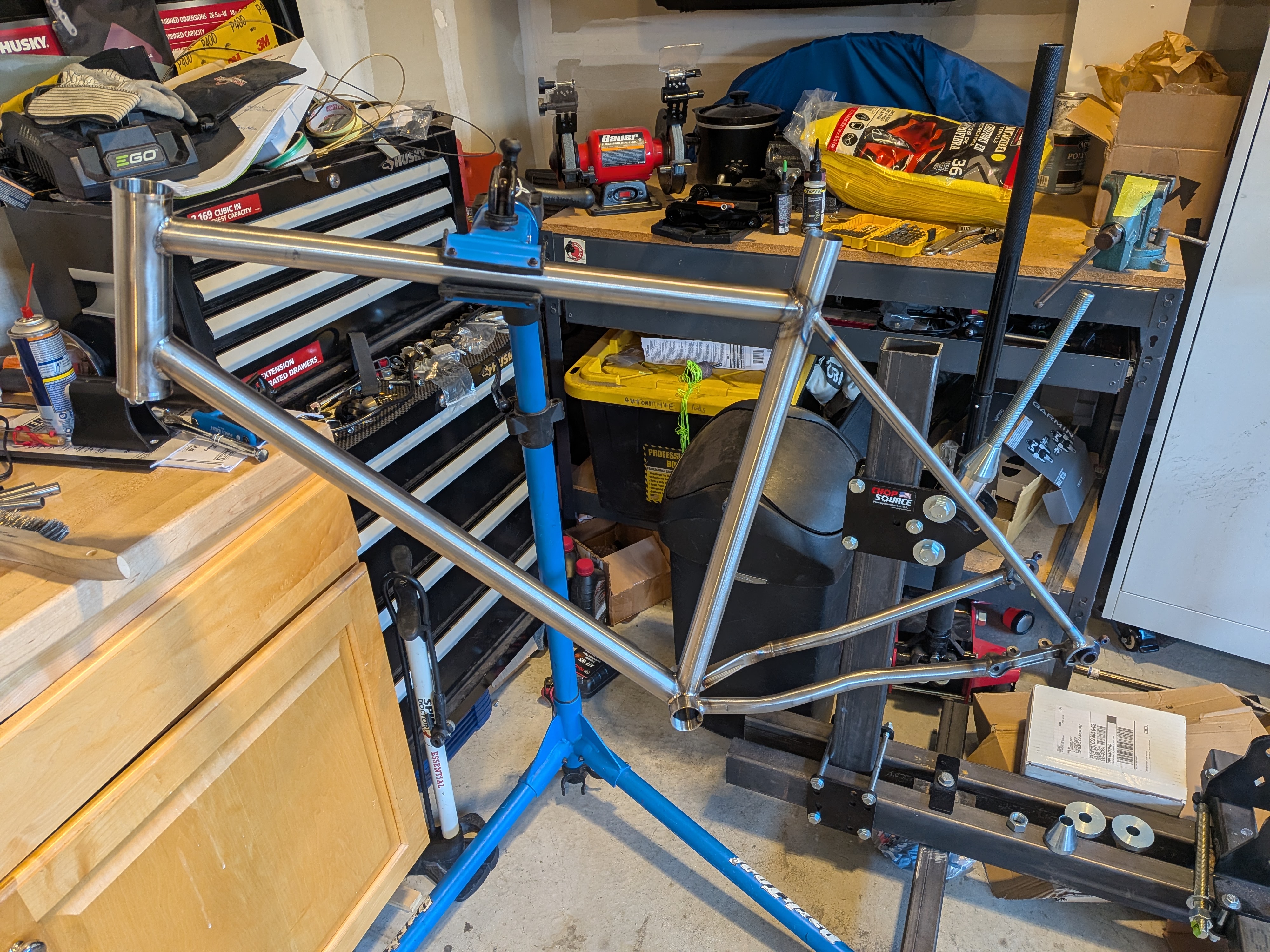
I have been practicing tig welding for a couple weeks and I think it all clicked today. Found the pulse settings that gave me incredible control. I believe I’m ready to move to a real bike (which I have for up in my jig already ), but want to make sure there isn’t any critical feedback before proceeding on that. Thanks for any feedback or advice!
Fyi- 40a peak, 50% low a, 33% on time, 140hz pulse
To me, from the pics, it seems acceptable. Maybe a little too hot? I would make sure you are in the comfortable position for each weld, I can see on the top of the tube you may have had some issues and I bet you were welding that part while in an uncomfortable position. I do much better welds when I am comfortable and I can see well, that takes me to move my piece several times before closing a tube.
140Hz seems odd to me, that’s very fast, I was on 2Hz (two pulses per second), I could see, for myself, going up to 3 or 4Hz but 140Hz are not even visible to the naked eye meaning you don’t know when you are at the top power vs when you are on the low end of the cycle.
Looks like a perfectly cromulent weld, I’d say go for it! If you want more encouragement, destructive test. Cut through the weld and see if it’s got good roots. Slip close fitting sturdy pipe over the tubes and lever on the weld to see what fails first and how.
I can’t say anything about pulse settings though. Did most of my TIG with big old transformer machines and still do all my pulsing with the pedal. Nothing wrong either way, do what works for you.
Those look decent to me! Now that you can do it right, you need to keep practising until you can’t do it wrong
But realistically, yes, jump in and make a frame.
FWIW I set the machine to 80A, no pulse, and use the pedal. I pulse it as I go (a bit more juice as the rod goes in). But whatever works for you.
I would recommend trying the joints with tricky angles and access on test offcuts as well. The joints you’re illustrating are relatively easy.
Another thing to always keep in mind is that every joint (except the small one between the ST and DT) on the frame is thin to thick.
Very thick BB shell, thick HT, thick externally butted ST, thick dropouts. So of course you always start the arc on the thicker tube and give it more of the heat. Worth practising with representative thicknesses. I cut up an old frame (which had failed anyway) so I could try all the individual joints.
Great Idea using an old frame to practice the thin to thick and acute angles. That’ll be my last round of practice before putting it to action on the real thing. Thanks!
My idea for the fast pulse is to be able to weld with the same technique I use without a pulse, but having better heat control. The puddle also seems to flow better for me. I messed around with slow 1-2 hz, but struggled with timing.
Yes have heard of people doing this. I don’t think my machine goes up to that fast so haven’t experimented with it!
I don’t like slow pulse either for the same reason. If you pulse the pedal yourself as you go you get to set the tempo. Sometimes you’re out of position or need to rearrange the rod or whatever. I’d rather be in control and not have it suddenly zap at my workpiece out of nowhere
There’s a common misconception that pulse on tig should match your puddles, one pulse per puddle and the frequency will determine how fast you work around that joint. While many people do that, and it can work great (I do it sometimes with the laywire technique), high frequency pulse is used with pretty much the same method as non-pulse. But (and this is a simplified explanation) you get the ability to have a high peak amperage (and so a very hot burst) but without the heat running away from you as easily.
As you tack and weld your frame, remember how heat pulls the frame. You want to use a sequence when welding, so you do not have to align so much when finished. And consider purging your cromoly, too. This reduces contamination. Take a look at Nate Zukas’ FB site. He really lays out sequencing. He is experienced and approachable. https://www.facebook.com/nate.zukas/
Your welds look good and you have good gas coverage!
I’d ride on those welds as well. Jump in and make the frame! Settings are going to be different for everyone. Differences in technique can mandate differences in settings. Sometimes you can turn up the heat, move faster, and end up with a smaller heat affected zone. People often start with low amperage and go slow, and the long dwell time ends up heat soaking your part. It happens, and steel is forgiving. As you progress, you learn to weld hotter and move faster, reducing the heat affected zone. Again, your welds will be fine. Weld that frame and hone your technique as you get more time with the torch.
This is totally a thing! I don’t remember where I heard it from (this was all a long time ago tbh) but that’s a thing I did for tacking aesthetically critical 304 joins on thin material. Tacking without adding filler eliminated a ton of grind and polish time.
Something like 35-50% low, somewhere between 100-200hz. The sudden large up/down current jumps makes the puddle wiggle around so it’s more likely thin edges might bump into each other before they decide to ball up in opposite directions. Could even jump a tack across small gaps with a little luck.
Makes a hell of a harsh buzz though. The rest of the shop made sure I was aware of the noise coming from 15 inches in front of my face.
Yes some fancy machines now even have a “tack” mode that does that kind of thing. With an old-school machine fusion tacks will almost never work unless the two pieces are actually touching, like properly touching because you’re clamping them down with a screwdriver.
I will never claim to be an expert, but for me, the more tacks the better. I found that tacking with the pulsar turned off is a game changer. My tacks are small and percise.